Back
UI/UX Design
MYGEECS
For a student in Lagos or Nairobi, studying abroad begins as a question nobody around them can fully answer.
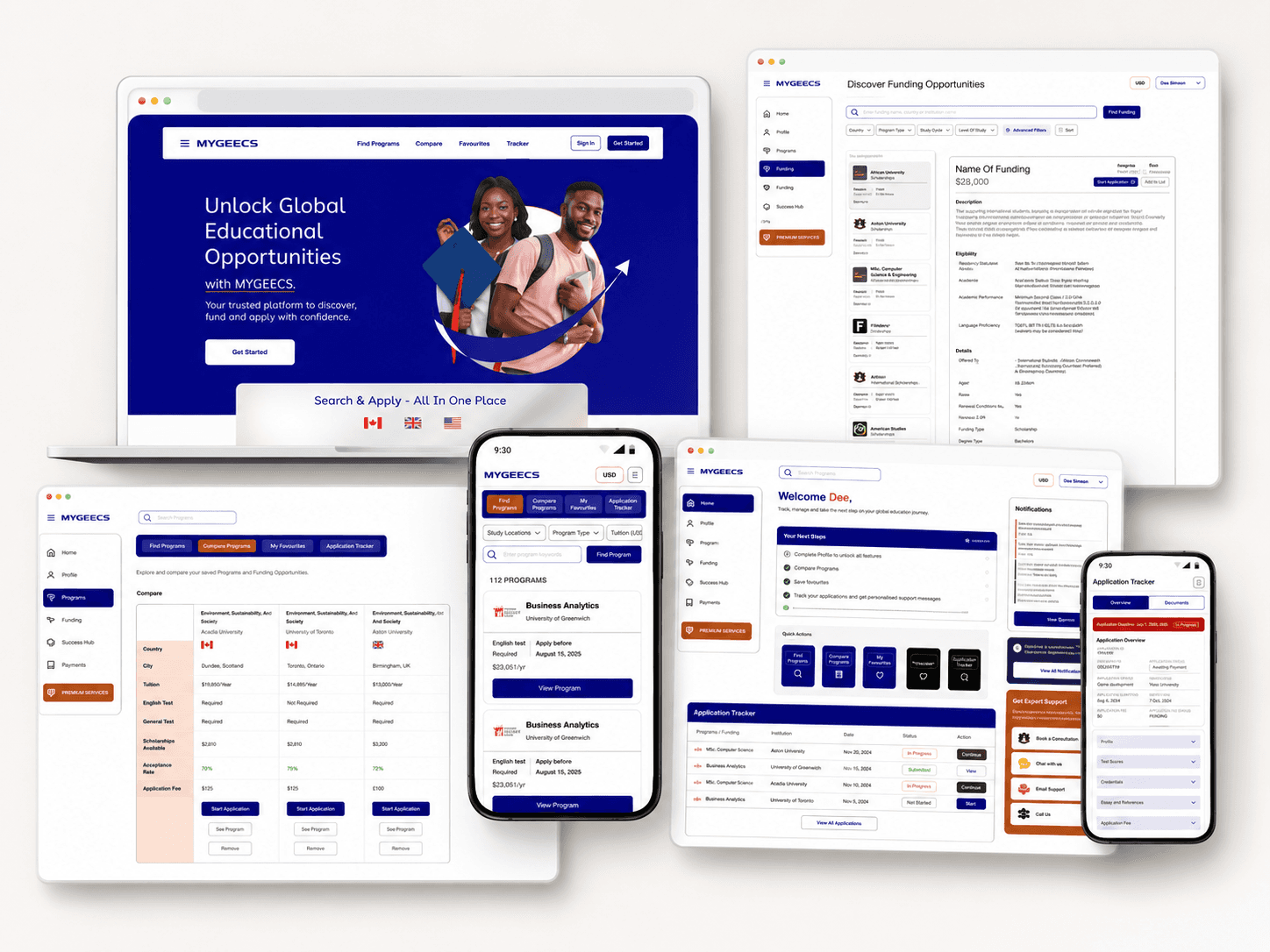
What I did: Led product design across the MYGEECS landing experience and student web app, from research framing and information architecture through the design system and engineering handoff.
Scope: Independent lead product designer, working with the founding team and engineering.
Outcome: The product shipped and is live across the full study-abroad journey, and the system I set became the standard the platform keeps building new surfaces on.
CONTEXT
Every year a large share of Africa's most ambitious students try to study abroad, and almost all of them start from the same place: scattered information and no clear map. The journey runs through university websites, scholarship databases, forums, test-prep providers, and a thick layer of agents and middlemen whose advice is uneven and often paid for. For a first-generation applicant, the process is expensive, high-stakes, and largely invisible until you are already deep inside it.
MYGEECS entered that gap with a single bet: pull the entire journey into one platform built specifically for African students reaching global universities. Not a search engine for courses, and not another agent with a landing page, but a guided system that carries a student from "I want to study abroad" through program discovery, funding, test prep, admissions guidance, and application tracking. The reach is wide by design, spanning programs across more than thirty countries.
For an emerging edutech company, that ambition is also the risk. A product trying to own the whole journey has to feel trustworthy and navigable on the first visit, usually on a phone, usually to someone who has never done this before and has no one to ask.

PROBLEM
The brief read like a product build: design the landing page and the student web app for web and mobile, ready for launch. The real problem sat underneath it. Studying abroad is a long, anxious, multi-stage funnel, and the moment a student lands on a platform claiming to handle all of it, the platform has to prove it can be trusted with a decision this big.
If the experience feels like another aggregator, students retreat to what they know: agents, WhatsApp groups, word of mouth. So the design problem was never a single screen. It was legibility and trust across a wide surface area. A student should be able to arrive, understand what MYGEECS does, see their own path inside it, and take the first step without feeling like they need a guide to use the guide.


ROLE
I led product design across the engagement as the lead product designer, engaged independently and working alongside the founding team and engineering. The information architecture, the flows, the wireframes and prototypes, and the design system were mine. Research framing and product structure sat with me. Backend and production execution were shared with engineering.
APPROACH


The first real decision was to stop treating MYGEECS as a list of features and start treating it as a sequence. The marketing surface names the capabilities, find a program, smart matching, easy applications, but a student does not think in features. They move through stages. So the product was structured around that movement: build a profile, see matched programs, find funding, prepare for tests, apply, and track everything in one place. The personalized roadmap became the spine that held the rest together.
That reframing solved the biggest risk directly. Instead of dropping a new user into a search box against thousands of programs, the profile-first model lets the platform lead. Smart Matching turns an overwhelming catalog into a short, relevant set tied to the student's own goals, which is what earns a second visit.
From there the work was designing the surfaces that carry the weight once a student commits. The application tracker, compare-programs view, funding and scholarship search, saved favorites, and service history were designed as one coherent dashboard rather than a set of disconnected tools, so the student always knows where they are in the journey and what comes next. Every surface was built mobile-first, since that is how most of this audience reaches the product.

Underneath all of it, I built the design system and style guide so a small team could ship consistently and keep shipping as the product grew. That decision was about the future more than the launch. A platform this broad fragments fast if every new surface is designed from scratch, and MYGEECS was always going to add surfaces.
OUTCOME
The product shipped and is live. The landing experience and the student web app run in production today, and the platform now spans the full journey it set out to own, from program discovery and funding through test prep and admissions guidance, across more than thirty countries.

The system did what it was meant to do beyond launch. The design language and component structure became the standard the team builds new surfaces on, from the partner and school pages to the success hub, the test-prep bootcamp, and the blog. And the engagement itself became ongoing rather than one-off. I remain the lead product designer on the platform, which is the clearest signal that the structure held.
The work was never about designing screens for an edutech startup. It was about giving a generation of students a legible path through a process that has stayed deliberately confusing for too long, and setting the product structure the platform keeps scaling on.
